Exosomes, growth factors, peptides and stem cells turn up on the same shelf, often on the same bottle, and they get used as if they were interchangeable. They are not. Each describes something genuinely different, and telling them apart makes it much easier to judge whether a product is worth your money.
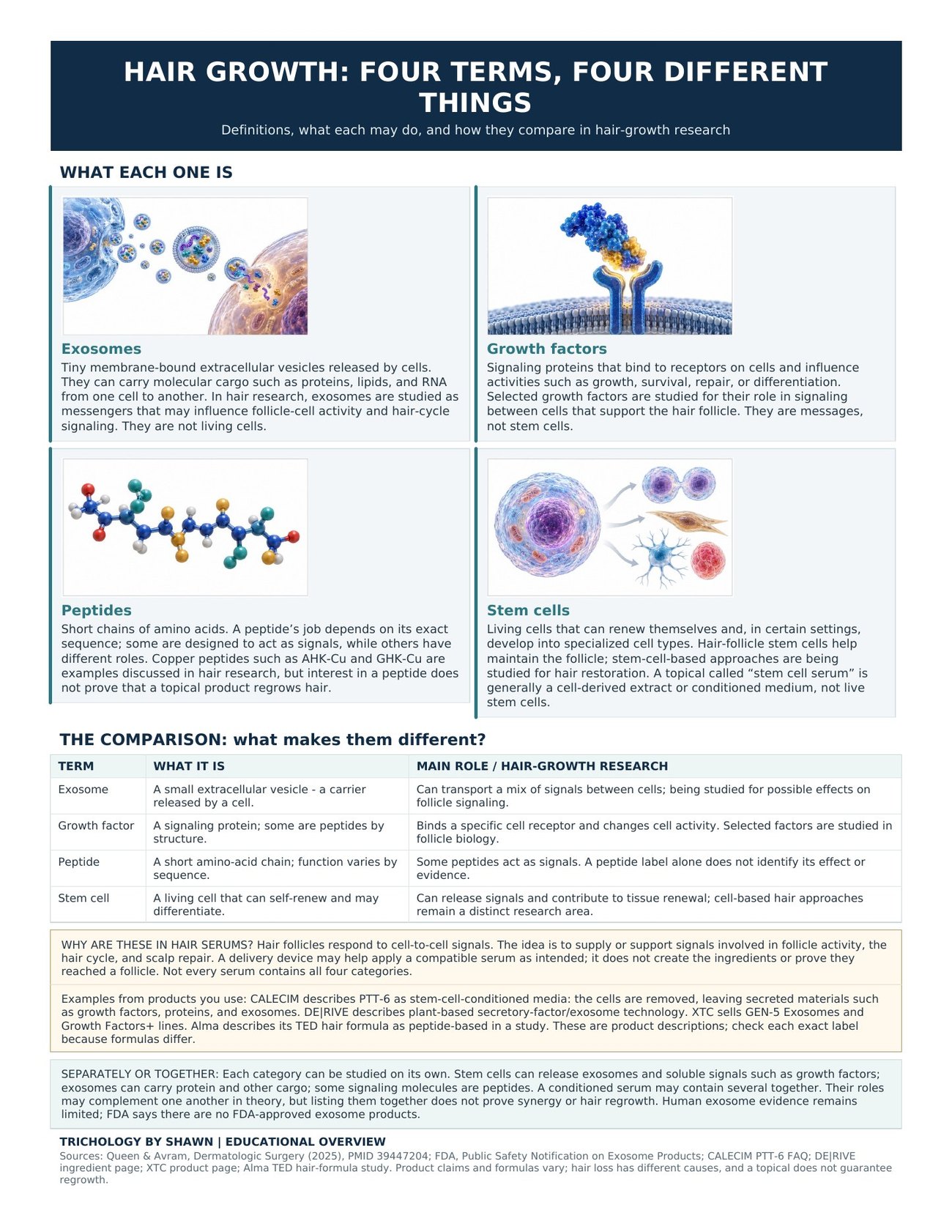
Exosomes are tiny membrane-bound extracellular vesicles released by cells. They can carry molecular cargo such as proteins, lipids and RNA from one cell to another. In hair research they are studied as messengers that may influence follicle-cell activity and hair-cycle signalling.
One thing to be clear about: they are not living cells. They are carriers.
Growth factors are signalling proteins that bind to receptors on cells and influence activities such as growth, survival, repair, or differentiation. Selected growth factors are studied for their role in the signalling between cells that supports the hair follicle.
They are messages, not stem cells. That distinction gets blurred constantly in marketing copy.
A peptide is a short chain of amino acids, and its job depends entirely on its exact sequence. Some are designed to act as signals, while others have completely different roles. The copper peptides AHK-Cu and GHK-Cu come up often in hair discussions, but interest in a peptide does not prove that a topical product regrows hair.
I went through the actual studies behind those two in a separate post on peptides.
Stem cells are living cells that can renew themselves and, in certain settings, develop into specialised cell types. Hair-follicle stem cells help maintain the follicle, and stem-cell-based approaches are being studied for hair restoration.
Here is where the naming misleads people most. A topical sold as a "stem cell serum" is generally a cell-derived extract or conditioned medium, not live stem cells.
| Term | What it is | Main role in hair-growth research |
|---|---|---|
| Exosome | A small extracellular vesicle, a carrier released by a cell. | Can transport a mix of signals between cells. Being studied for possible effects on follicle signalling. |
| Growth factor | A signalling protein. Some are peptides by structure. | Binds a specific cell receptor and changes cell activity. Selected factors are studied in follicle biology. |
| Peptide | A short amino-acid chain. Function varies by sequence. | Some peptides act as signals. A peptide label alone does not identify its effect or its evidence. |
| Stem cell | A living cell that can self-renew and may differentiate. | Can release signals and contribute to tissue renewal. Cell-based hair approaches remain a distinct research area. |
Hair follicles respond to cell-to-cell signals, so the idea is to supply or support the signals involved in follicle activity, the hair cycle, and scalp repair. That logic is sound.
Two cautions go with it. A delivery device may help apply a compatible serum as intended, but it does not create the ingredients and it does not prove they reached a follicle. And not every serum contains all four categories, whatever the front of the box implies.
It is easier to see the difference with real examples. These are the manufacturers' own product descriptions, not my testing of them.
Those four descriptions span three different categories, and the CALECIM one illustrates the stem cell point exactly: conditioned media, not live cells. Product claims and formulas vary, so check each label rather than trusting the category word on the front.
Each category can be studied on its own, and they also overlap. Stem cells can release exosomes and soluble signals such as growth factors. Exosomes can carry protein and other cargo. Some signalling molecules are peptides. A conditioned serum may contain several of them together.
Their roles may complement one another in theory, but listing them together does not prove synergy, and it does not prove hair regrowth. Human exosome evidence remains limited, and the FDA states there are no FDA-approved exosome products.
A 2024 review in Dermatologic Surgery gathered the clinical studies published to that point, covering roughly 125 patients, and found side effects were rare. The authors' conclusion is the part to carry with you: larger trials, consistent manufacturing standards, and regulatory oversight are needed before efficacy and safety can be confirmed.
None of this makes these ingredients worthless. It makes them an emerging category where the labelling is looser than the science, and where the same bottle can be described several different ways depending on what the marketing team wanted to emphasise.
The question that matters comes earlier anyway. Hair loss has different causes, and a topical does not guarantee regrowth. Pattern thinning, a stress-triggered shed, traction from styling, and an inflamed scalp are four different problems, and a signalling serum is a different proposition in each one. A scalp analysis sorts that out first, under magnification, before anyone talks about what to put on it.
This article is for educational purposes and is not medical advice. It summarizes general scientific background, regulatory status, and manufacturers' published product descriptions, and does not endorse any specific product. Formulas differ, so check each label. For diagnosis or treatment of a medical condition, please consult a qualified healthcare provider.
Start with a professional scalp analysis with Shawn at Chameleon Salon in Montrose or Primary Care 4 Hair in Newport Beach. Call (818) 790-9858 or send a message.
Book a Scalp Analysis