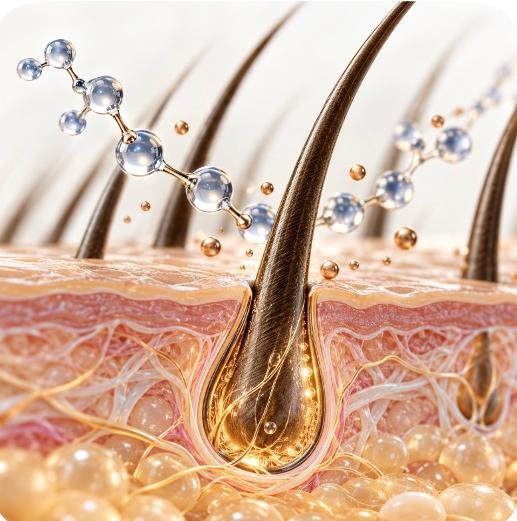
Walk down any hair care aisle, or scroll for thirty seconds, and you will run into peptides. Copper peptides in particular, usually GHK-Cu or AHK-Cu, now appear on the front of serums that promise thicker, denser hair. The ingredient is real and the science behind it is genuinely interesting. What gets lost is the gap between interesting and proven.
Clients ask me about this constantly, so here is a plain reading of what the research actually says.
A peptide is a short chain of amino acids, the same building blocks that make up proteins. Because they are small, certain peptides act as signals rather than structure. They tell nearby cells to do something: divide, produce collagen, calm down. Copper peptides are peptides bound to a copper ion, and copper is involved in a number of processes in skin and tissue repair.
That signalling idea is why they turned up in hair research in the first place. If a follicle has become sluggish rather than gone, a signal is a reasonable thing to try.
The most quoted human trial was published in Annals of Dermatology in 2016. It was a randomized, double-blind, six-month study of 45 men between 20 and 60 with male pattern hair loss. Participants received one of two concentrations of a formula called ALAVAX, or a placebo.
At six months, hair counts rose meaningfully in both treatment groups compared with placebo. Hair length and thickness, however, showed no significant difference between the groups, and patient satisfaction ratings were modest across the board.
Here is the part that usually gets dropped when the study is quoted in marketing. ALAVAX is not a peptide on its own. It is a complex of GHK peptide and 5-aminolevulinic acid, or 5-ALA. When two active ingredients are tested together, the study cannot tell you which one did the work, or whether either would do anything alone. It is also worth noting that the study used GHK, not the copper-bound GHK-Cu that most serums advertise.
Forty-five men across three groups is also a small trial. Small studies produce noisier results, which may be why the lower concentration outperformed the higher one, a pattern you would not expect if the effect were straightforwardly dose-dependent.
AHK-Cu has its own frequently cited paper, published in Archives of Pharmacal Research in 2007. Researchers applied the tripeptide-copper complex to human hair follicles and to cultured dermal papilla cells, the cells at the base of the follicle that help govern the growth cycle. At very low concentrations it lengthened follicles, encouraged those cells to multiply, and reduced markers of programmed cell death.
Those are encouraging findings. They are also laboratory findings. Follicles in a dish and follicles in a living scalp are not the same system, and a great many ingredients that perform well in vitro never reproduce the effect on a person's head. A promising lab result is a reason to run a clinical trial, not a substitute for one.
In an honest middle position. There is a plausible mechanism, one small combination trial in humans, and supportive laboratory work. There is not yet the kind of evidence that would let anyone call a copper peptide a standalone treatment for hair loss, and I would be cautious of any product page that implies otherwise.
That does not make peptides useless. It makes them an emerging ingredient worth watching, best considered as one component of a plan rather than the plan itself.
Whether any ingredient is worth your money depends entirely on what is driving your hair loss, and that is the step most people skip. Pattern thinning driven by hormones, shedding triggered by surgery or illness, traction from styling, and an inflamed scalp are four different problems. A peptide serum is a different proposition in each case, and in some of them it is beside the point.
A scalp analysis answers that question first. Under magnification we can see whether follicles are miniaturizing, whether the scalp is inflamed, and whether the pattern is diffuse or localized. Then it is worth talking about what to put on it.
This article is for educational purposes and is not medical advice. It summarizes published research and does not endorse any specific product. For diagnosis or treatment of a medical condition, please consult a qualified healthcare provider.
Start with a professional scalp analysis with Shawn at Chameleon Salon in Montrose or Primary Care 4 Hair in Newport Beach. Call (818) 790-9858 or send a message.
Book a Scalp Analysis